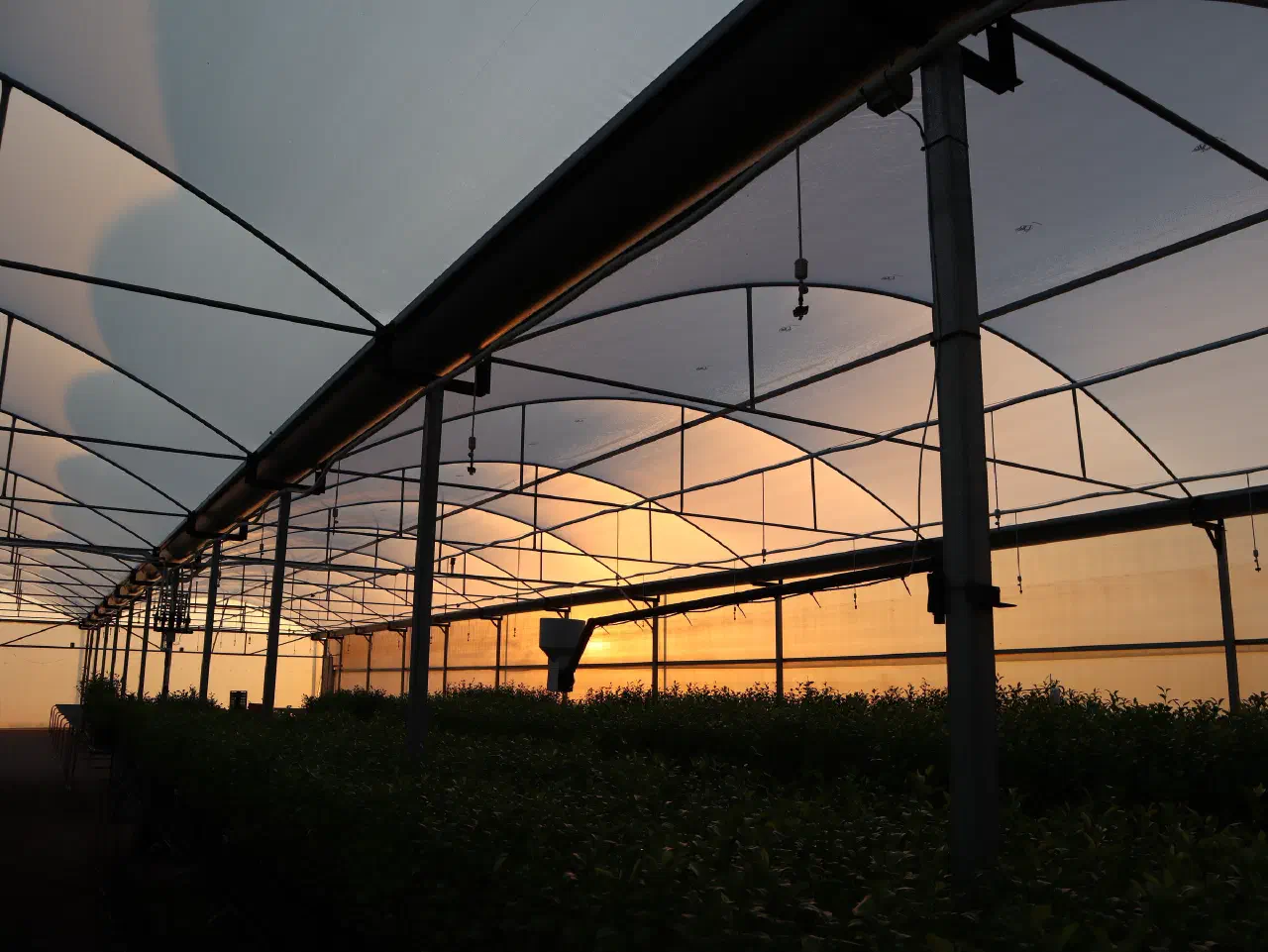
Plants don’t read thermometers. They don’t respond to temperature alone, or humidity alone. They respond to the relationship between them: specifically, to the difference between the vapour pressure of water inside their leaves and the vapour pressure of the surrounding air.
That difference has a name: Vapour Pressure Deficit, or VPD.
It’s the metric that determines whether a plant is actively growing, conserving water, or quietly stressed. It drives transpiration, nutrient uptake, and stomatal behaviour. Commercial greenhouse operators have used VPD as their primary climate metric for decades. Most small-scale growers (market gardeners, hobby glasshouse operators, urban food producers) have never encountered it, because the equipment to measure and act on it has cost thousands of dollars and required specialist configuration.
We built open-source tools so you could.
What VPD Actually Tells You
When VPD is too low (say, below 0.4 kPa), the air is nearly saturated. The plant can’t transpire effectively, which means it can’t draw nutrients up through its roots or cool itself. Fungal pathogens thrive in these conditions. Growth slows. Disease risk climbs.
When VPD is too high (above 1.6 kPa in most crops), the air is pulling moisture out of the plant faster than the roots can supply it. The plant’s response is to close its stomata. That stops water loss, but it also stops CO₂ uptake, effectively switching off photosynthesis. The plant isn’t dying, but it isn’t growing either.
The productive window sits between roughly 0.8 and 1.2 kPa for most warm-season crops, with variation by species, growth stage, and time of day. Staying in that window (through misting, ventilation, heating, and shading) is what separates a high-yield controlled environment from a polytunnel that sometimes works and sometimes doesn’t.
VPD is calculated from air temperature and relative humidity using the Tetens equation. The numbers come from sensors you can buy for under $30. The intelligence comes from knowing what to do with them.
The Hardware
We’ve built and deployed monitoring and control systems on two open hardware platforms, each suited to different scales and contexts.
Modular Wireless Sensor Platform: For Distributed Deployments
This platform is designed for exactly this kind of environmental sensing work. Individual sensor modules connect directly to a base board (no custom PCB or advanced soldering required) and the system supports both WiFi and LoRaWAN connectivity depending on what the site demands. The modular design means sensors can be added, swapped, or upgraded without replacing the base hardware.
Our build combines:
- Four-in-one atmospheric sensor measuring air temperature, relative humidity, barometric pressure, and volatile organic compounds (VOC / air quality index). This is the primary input for VPD calculation.
- RS485 expansion module connecting Modbus soil and foliar sensors to the base platform over the industrial serial bus
- Multi-parameter soil sensor measuring soil moisture, temperature, electrical conductivity, and salinity at the root zone, a full picture of the root environment in a single probe
- Secondary atmospheric sensor: a Modbus temperature and humidity probe useful for detecting stratification in taller growing spaces, where conditions at canopy height may differ significantly from floor level
- Leaf wetness sensor: an analogue resistive sensor detecting surface moisture on foliage, which gates irrigation and misting decisions (no point irrigating an already-wet canopy)
The WiFi connectivity module handles local MQTT integration for sites with wireless infrastructure. Swapping in the LoRaWAN connectivity module instead extends the platform to remote or off-grid deployments, connecting to the community network without running cable.
Integrated All-in-One Controller: Standalone Glasshouse Management
Where the modular platform is a sensing node, this is a complete integrated controller. A high-performance microcontroller with ample processing headroom and local storage runs real-time control logic, hosts a local web dashboard, and logs data, all in a single sealed enclosure. The board integrates RS485, Ethernet, LoRa radio, and a colour display, eliminating the need for separate communication hardware or external display modules.
This is the platform we use when we need a fully self-contained glasshouse controller: one that displays live sensor readings and system state on a built-in screen, serves its own web dashboard on the local network, and makes all control decisions independently without depending on any external system. If the internet is down, it keeps growing. If the network server is unavailable, it keeps growing.
The same sensor stack connects via the integrated RS485 interface: atmospheric sensors, soil sensors, and a leaf wetness probe. An industrial multi-channel Modbus relay board controls the actuators (misting nozzles, exhaust fans, circulation fans, irrigation valves, heating elements) via the same RS485 bus.
The Control Logic
Both platforms run the same core control architecture: a state machine, deterministic, predictable, and safe. At every measurement cycle, the system evaluates sensor readings against configured thresholds and transitions between states accordingly. There’s no ambiguity about what the system will do in any given condition.
VPD-driven misting: When VPD rises above 1.25 kPa, the misting system activates in 10-second bursts. A minimum interval of five minutes between activations prevents overuse and waterlogging. Leaf wetness readings gate this decision: if the canopy is already wet, misting is suppressed regardless of VPD.
Soil moisture irrigation: Hysteresis control keeps soil moisture between 30% and 40% by default (adjustable per crop). Irrigation runs for a minimum of one minute to avoid short cycling, then waits at least five minutes before the next evaluation. Leaf wetness above 80% disables irrigation as a disease-prevention measure.
Ventilation: Exhaust fans trigger when air temperature exceeds 30°C. Circulation fans run on a time-based cycle (15 minutes active per hour) to prevent humidity stratification and maintain even CO₂ distribution throughout the growing space.
Alarms: A multi-level alarm system (Info, Warning, Error, Critical) logs anomalies (sensor failures, temperature extremes, stuck relays, communication timeouts) and surfaces them through Home Assistant notifications or on-device display alerts.
What the Data Looks Like
Every sensor reading and control event is logged to local storage with automatic rotation. The web dashboard, accessible on the local network without any app or cloud account, shows real-time readings, relay states, VPD history, and alarm status. A grower can walk into the glasshouse with a phone and see exactly what the system is doing and why.
Data flows to Home Assistant via MQTT, where it drives broader farm automations, triggers notifications, or integrates with irrigation schedules from other systems. Local intelligence comes first: if the internet is down, the controller keeps working. If Home Assistant is unavailable, the controller keeps working.
VPD in Practice
VPD monitoring transforms how you manage a controlled growing environment. Instead of adjusting conditions by intuition (“it feels dry” or “the plants look a bit stressed”), you’re responding to numbers that correlate directly with plant physiology. You can track VPD over a full growing cycle and correlate it against yield data. You can identify the hours of the day when your glasshouse consistently spikes into the stress range. You can test whether raising shade cloth at noon actually moves VPD into the productive window or just costs you growth hours.
| Growth Stage | Target VPD (kPa) | If Too High | If Too Low |
|---|---|---|---|
| Propagation / Seedlings | 0.4 – 0.8 | Mist lightly; check heating | Improve airflow; reduce humidity |
| Vegetative Growth | 0.8 – 1.2 | Mist or ventilate | Ventilate; check for leaks |
| Flower / Fruit Ripening | 1.2 – 1.6 | Ventilate; add shade if temperature-driven | Reduce misting; improve drainage |
That kind of iterative, evidence-based refinement is what commercial operations use to maintain consistent yields year-round. It requires sensors, good software, and the time to understand what the data is saying.
Beyond the Glasshouse
VPD monitoring changes what’s possible in controlled growing environments, but the underlying principle extends further. These tools demonstrate that the sensing and automation capabilities that commercial operations treat as competitive advantages don’t have to be proprietary.
A small market gardener running a polytunnel can tell whether their tomatoes are heat-stressed without a $15,000 climate controller. A school kitchen garden can diagnose why their seedlings are damping off, with real data rather than a consultant. A community grower can decide whether to irrigate today without paying for a subscription.
The data is simple. The sensors are cheap. The integration, turning raw readings into action, is where the real work lies. That’s what this project is building, in the open, for anyone to use, adapt, and improve.
These tools carry no subscription fee, but they’re not free to build. The firmware, the Home Assistant integrations, and the sensor stack are maintained by contributors giving their time. If they work for you, the best thing you can do is help others get started, report what breaks, or support the upstream projects financially.
Get Involved
Both hardware platforms are active, deployed, and generating real data in South Australian growing environments. The hardware and firmware are currently being tested and refined. Documentation and full public release will follow once we’re confident in the build.
If you’re running a glasshouse, polytunnel, or other controlled growing environment and want to trial VPD-based management, we’d like to hear from you. We can supply hardware to growers who are comfortable working alongside us through the testing phase. Real crops in real conditions are how we learn what to refine. Get in touch through the contact page .
Build guides covering sensor wiring, RS485 configuration, and Home Assistant integration will be published as the system matures.