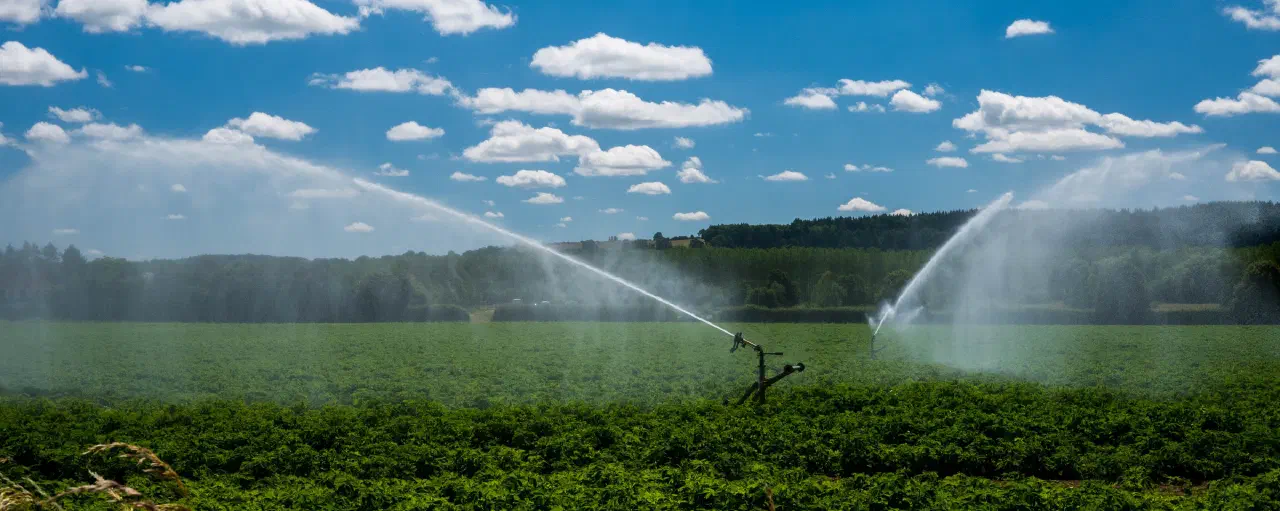
South Australia is the driest state on the driest inhabited continent. We don’t have water to waste.
Most irrigation systems ignore this. They run on timers. Tuesday at 6am, eight minutes, regardless of whether it rained yesterday, whether the soil is still saturated from last week, whether the leaves are already wet and adding more moisture would invite fungal disease. Industrial schedules applied to living systems. We’ve spent decades building agricultural infrastructure that treats water as if it were infinite.
The first step toward better water stewardship isn’t better valves. It’s better listening.
Hearing What the Soil Is Saying
These projects build open-source irrigation control systems that make decisions based on actual soil conditions, not schedules, not guesswork. They read the ground before they open a valve.
These systems read the soil directly via RS485 Modbus sensors in the root zone and canopy:
- Volumetric soil moisture and temperature sensors measuring the water content and temperature of the root zone, the two primary signals for irrigation decisions
- Leaf wetness sensors that detect surface moisture on foliage, critical for preventing irrigation when disease risk is already elevated
- Air temperature and humidity sensors for atmospheric context, VPD calculation, and early warning of heat stress or frost risk
These sensors communicate over RS485, an industrial serial standard designed for reliable data transmission in electrically noisy environments like farms. No WiFi dropouts. No Bluetooth pairing problems. A daisy-chained bus that can run 1.2km from the controller with correct termination.
LoRaWAN: The Community Network That Connects It All
The sensor data needs to travel from field to controller without relying on mobile coverage or running cables across a whole property. That’s where LoRaWAN comes in: specifically, the community-owned LoRaWAN network that The Things Network South Australia has built across the Adelaide region.
LoRaWAN (Long Range Wide Area Network) operates on unlicensed spectrum, uses almost no power, and can reach sensors 2–15km away depending on terrain. A single gateway installed on a shed or farmhouse covers an entire small property. Multiple gateways (contributed by neighbours and community members) cover a region.
No monthly fees. No telco dependency. No per-message billing. What you build belongs to you and your community.
Two Systems for Different Scales
Compact LoRaWAN Relay Controller: Market Gardens and Glasshouses
This is a purpose-built LoRaWAN control node combining wireless connectivity with an integrated multi-channel relay bank in a single compact unit (no separate relay hardware required for smaller installations). It reads multiple RS485 Modbus sensors on a shared bus and controls eight irrigation valves or pump circuits independently. Polling intervals are configurable to balance data granularity against radio transmission frequency.
A custom decoder translates the compressed sensor payloads on the ChirpStack network server, unpacking soil moisture and temperature readings into structured data before they reach the database. Valve control runs in reverse: commands from Home Assistant trigger specific channels, translated back into the appropriate bus commands at the device. The entire configuration is done through the network server; no local access to the field device is required for day-to-day operation.
Suited for: intensive market gardens, polytunnels, glasshouses, urban growing operations.
Industrial LoRaWAN IoT Controller: Larger Properties
This is a ruggedised, industrial-grade controller built for permanent outdoor installation, rated for temperature extremes, housed in weatherproof enclosures, and designed to run continuously on 24V DC power from a solar or mains supply. It bridges a full RS485 Modbus bus (sensors and relay boards) to the LoRaWAN network using Class C connectivity, which keeps the radio receiver active and enables low-latency downlinks essential for responsive valve control.
An industrial multi-channel Modbus relay board connects to the controller via the shared RS485 bus, providing eight independently controllable outputs, enough for a multi-zone drip system or a combination of irrigation zones and pump control. The bus architecture means additional relay boards or sensor probes can be added to the same cable run without rewiring the controller.
Suited for: orchards, larger market gardens, rural properties with multiple irrigation zones.
Fail-Safe by Design
An irrigation system that fails open, that keeps watering when it loses connectivity, can destroy a crop in a day and waste thousands of litres. Both systems are built with safety as the first constraint, not an afterthought.
The industrial controller uses timed relay commands: pulse instructions that activate a valve for a specified duration, then cut it regardless of whether a close command is ever received. If the LoRaWAN link goes down after a valve opens, the hardware timer closes it anyway. The system cannot get stuck open.
The compact controller applies the same principle through software-enforced safety timers in the relay firmware. All outputs default to off on startup and power loss. Manual override (the ability to close all valves immediately from Home Assistant or directly at the device) is always available regardless of automation state.
The Data Stack
Field sensor data flows through a chain of open-source tools, each component replaceable, each data format documented:
- RS485 bus: sensors and relay boards on a daisy-chained industrial bus
- LoRaWAN node: field controller encoding sensor readings as compact payloads and receiving valve commands as downlinks
- ChirpStack V4: open-source LoRaWAN network server decoding payloads via custom JavaScript codecs
- InfluxDB v2: time-series database storing every sensor reading with timestamp and device metadata
- Grafana: dashboards visualising soil moisture trends, temperature, and irrigation events over time
- Home Assistant: automations, alerts, manual override, and integration with the broader farm control system
You own every layer. The data lives on your infrastructure, not on a vendor’s servers. You can query it, export it, analyse it, or hand it to an agronomist without asking anyone’s permission. The SEIN automation stack describes how these components connect at the software level.
What This Makes Possible
A soil moisture trigger set at 25% means irrigation starts automatically when the root zone dries below that threshold, not on Tuesday at 6am. A leaf wetness interlock means irrigation won’t run on an already-wet canopy, regardless of what the schedule says. A temperature reading climbing through the day can trigger pre-emptive irrigation before heat stress sets in rather than after.
These aren’t exotic capabilities. They’re what the data already enables, once the infrastructure to capture and act on it is in place. The difference between a system that waters by the clock and one that waters by the soil is the difference between managing by assumption and managing by knowledge.
Why Not Just Buy a Commercial System?
Commercial precision irrigation management systems work. They also typically cost $20,000–$80,000 installed, require annual subscriptions, tie you to a single hardware vendor, and stop working when that vendor is acquired, pivots, or goes out of business.
The approach described here uses components that cost $50–$300 per sensor node, runs on open-source software with no subscription fees, and connects via community infrastructure that nobody can switch off. It’s not a product. It’s knowledge, and knowledge can be shared, adapted, and improved by anyone.
“No subscription fees” does not mean no cost to anyone. ChirpStack, InfluxDB, Grafana, and Home Assistant are built by contributors who give their time and expertise. The Things Network South Australia runs on gateways that people own, power, and maintain. If this stack works for you, contribute back: run a gateway, report a bug, write a build guide, or support the upstream projects financially.
Current Status & Collaboration
Both systems are deployed and operating in South Australian growing environments. The hardware and firmware are actively being tested. Full documentation and public release will follow once the systems are stable and properly documented.
If you’re running a market garden, an orchard, or a larger growing operation in South Australia (or anywhere with LoRaWAN coverage) and want to be part of the testing process, get in touch through the contact page . We can supply hardware to growers who are comfortable working alongside us through troubleshooting and refinement. That hands-on feedback is how these systems get better.
Configuration guides, decoder scripts, and wiring diagrams will be published progressively as the systems are documented.