Table Of Contents
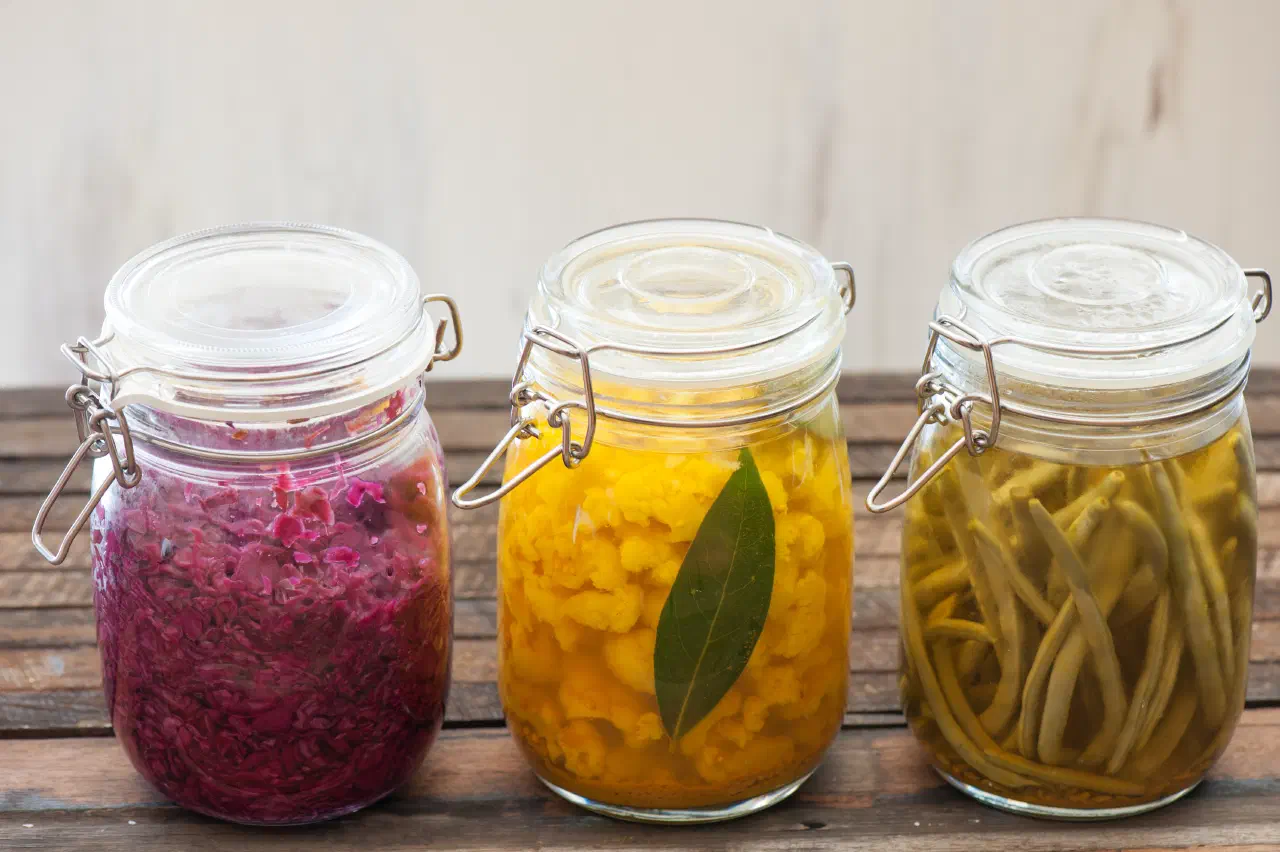
If you’ve ever stood over a jar of fermenting vegetables (watching bubbles rise, catching that sharp, tangy scent), you’re witnessing something extraordinary: an invisible ecosystem, busy at work.
It’s easy to think of fermentation as chemistry, but really, it’s ecology: a dance of bacteria, yeasts, enzymes, and time. And when we ferment, we’re not the masters of this process. We’re the collaborators.
The Microbial Majority
For all our human cleverness, we’re a minority species. Microbes were here first, and they quietly run the planet, decomposing, recycling, fermenting, digesting, transforming.
Our bodies, too, are ecosystems: trillions of microbes living in and on us, helping us digest food, shape our immune systems, even influence our moods. In a very literal way, we are never alone.
When we ferment, we make that partnership visible. A jar of sauerkraut is a small-scale version of a thriving ecosystem, with lactobacillus converting sugars into acids, pushing out pathogens, balancing the microbial community until it finds its own stability.
It’s not control. It’s collaboration.
Ecological Intelligence in Action
There’s a quiet intelligence at work in fermentation, not the kind that sits in a brain, but the kind that emerges when life interacts with life.
Microbes “know” how to balance themselves. They adapt to salt, temperature, and oxygen levels. They sense competition, form alliances, and build resilience. They’re constantly solving problems, but they do it collectively, through chemistry rather than consciousness.
And maybe that’s a kind of wisdom our modern systems have forgotten: diversity and cooperation create stability. That’s as true in a fermenting jar as it is in soil, forests, and societies.
Fermentation, then, becomes a teacher, showing us that complex, self-organising systems don’t need micromanagement. They need trust and respect for the natural intelligence of life.
Living with the Unseen
In a world obsessed with sterility and control, letting food “go microbial” feels almost subversive. We’ve been taught to fear bacteria: to sanitise, disinfect, pasteurise.
But fermentation invites us to reframe microbes as allies, not enemies. It reminds us that life depends on decay, that transformation requires surrender.
Every time we stir a ferment, we’re reminded: cleanliness isn’t sterility, and safety isn’t the absence of life. A good ferment is a balancing act, not between good and bad, but between many kinds of life finding equilibrium together.
That’s a lesson far beyond the kitchen.
Culture as Culture
There’s a lovely linguistic accident here: we call both microbes and societies “cultures.” And perhaps it’s not an accident at all. Both depend on shared conditions, mutual nourishment, and the exchange of ideas, or in the microbial case, genes.
A thriving microbial culture mirrors a thriving human one: diverse, adaptive, resilient. Each organism has its role. Each contributes something that keeps the whole alive.
When we nurture a sourdough starter or a kombucha SCOBY, we’re tending to culture in every sense, biological and social. It’s a daily act of participation in the web of life.
Microbial Thinking
What would it mean to think more like microbes, to build communities that, like them, thrive through cooperation and exchange?
Microbes don’t hoard resources; they metabolise what’s available and share by-products that others can use. They don’t operate as individuals but as networks, always sensing and responding.
That’s not so different from the world we need to create: resilient, decentralised, interdependent. In the fermenting jar, we can glimpse a model for a more ecological kind of intelligence, one that values connection over control.
Closing the Loop
Fermentation bridges science and spirit, biology and belonging. It’s one of the few everyday acts where we can literally watch life transform matter, not as observers, but as participants.
When we ferment, we join the microbial conversation. We learn patience, humility, and trust in processes we can’t see but can sense.
And perhaps most importantly, we remember that the intelligence that sustains the world isn’t human at all: it’s microbial. It’s bubbling quietly in our kitchens, reminding us that collaboration, not domination, is what keeps life alive.